Physiological Sigh: The Two-Inhale Breath, the Stanford Trial, and When Operators Use It

The fastest way to change your state is a breath your body already knows how to take.
You have done a physiological sigh thousands of times without deciding to. A child does one at the end of crying. You do one when a hard call ends well. Two inhales stacked on top of each other, then a long exhale, and the chest drops.
The deliberate version is the one that matters to an operator. It takes thirty seconds, needs no app, and in the one randomised trial that tested it head to head, five minutes a day of it did more for mood and breathing rate than box breathing or mindfulness meditation.
This article gives you the breath itself, why the second inhale is the point, what the trial found and where its limits are, how it compares with box breathing, three moments in an operator's day where it earns its place, and the five-minute daily practice the trial used. Education, not medical advice: if you have a heart or respiratory condition, or you are pregnant, talk to your doctor before taking up any breathing practice. The trial itself excluded such participants.
What a physiological sigh is
A sigh is not a mood. It is a specific breath with its own brainstem machinery. The 2016 paper in Nature, "The peptidergic control circuit for sighing," opens with the definition: "Sighs are long, deep breaths expressing sadness, relief or exhaustion. Sighs also occur spontaneously every few minutes to reinflate alveoli, and sighing increases under hypoxia, stress, and certain psychiatric conditions."
That sentence carries two facts worth keeping. Sighs happen on their own, every few minutes, and their job is mechanical: reinflating the small air sacs of the lung. And the body produces more of them under stress. The deliberate physiological sigh borrows a reflex the nervous system already runs.
The researchers found the circuit in mice: "a peptidergic sigh control circuit in murine brain," built from small groups of neurons in the breathing centre. When they removed the receptor-bearing cells, the result was striking in its specificity: "Ablating receptor-expressing neurons eliminated basal and hypoxia-induced sighing, but left breathing otherwise intact initially." Sighing is its own system, separate from ordinary breathing. That is mouse biology, and the human circuit is inferred, not shown, but it explains why the sigh feels different from a deep breath. It is different.
How to do it
The instructions below are the ones participants received in the 2023 trial, published in Cell Reports Medicine as "Brief structured respiration practices enhance mood and reduce physiological arousal." Participants were told "to inhale slowly, and that once their lungs were expanded, to inhale again once more to maximally fill their lungs," then "to slowly and fully exhale all their breath."
- First inhale, through the nose. Slow, until the lungs feel comfortably full.
- Second inhale, through the nose. A short top-up to fill the lungs completely. The trial told participants that "it is normal for the second inhale to be briefer than the first."
- Long exhale, through the mouth. Slow and complete, longer than the two inhales combined. The trial's instruction was that "ideally, both inhales would be performed via their nose and the exhale would be performed via their mouth," with nose-only breathing as an acceptable alternative.
- Repeat for one to three breaths when you need a state change, or for five minutes as a daily practice.
The university's own write-up of the study compresses it to one line: "Breathe in through your nose. When you've comfortably filled your lungs, take a second, deeper sip of air to expand your lungs as much as possible. Then, very slowly, exhale through your mouth until all the air is gone."
Sit or lie down for the five-minute version. For the one-breath version, do it wherever you are, including on a call with the camera off.
Why the second inhale matters
Most calming breath patterns work on one variable: slowing the breath. The physiological sigh works on two. The trial authors describe cyclic sighing as differing from the other groups "in two main ways: (1) extended exhalation and (2) the double inhale, which increases the depth of inhalation."
Depth is the mechanical part. The Nature paper's definition already told you what sighs do: "reinflate alveoli." A lung that has been shallow-breathing at a desk for two hours has air sacs that have partly collapsed; the second inhale is the top-up that opens them. The long exhale is the autonomic part, the lever that most slow-breathing practices pull.
On that second lever, the 2018 systematic review in Frontiers in Human Neuroscience, "How Breath-Control Can Change Your Life," covered slow breathing techniques, defined as under 10 breaths per minute, across 15 studies out of 2,461 abstracts screened. Its finding: "Slow breathing techniques promote autonomic changes increasing Heart Rate Variability and Respiratory Sinus Arrhythmia." Higher HRV is the recovery signal operators already track, which is why the sigh pairs naturally with the HRV protocol for founders.
There is also a reason breath reaches the mind at all. A 2017 paper in Science, "Breathing control center neurons that promote arousal in mice," starts from the observation that "Slow, controlled breathing has been used for centuries to promote mental calming, and it is used clinically to suppress excessive arousal such as panic attacks." The researchers identified "a neuronal subpopulation in the mouse preBötzinger complex (preBötC), the primary breathing rhythm generator, which regulates the balance between calm and arousal behaviors." Those neurons "project to, synapse on, and positively regulate noradrenergic neurons in the locus coeruleus, a brain center implicated in attention, arousal, and panic." The breathing rhythm generator has a wire running to the arousal centre. Mouse data again, but it is the clearest anatomical account yet of why changing how you breathe changes how alert you feel.
What the trial found
The 2023 trial is the reason the physiological sigh moved from physiology lecture to practice. In the authors' words, it was "a remote, randomized, controlled study ( NCT05304000 ) of three different daily 5-min breathwork exercises compared with an equivalent period of mindfulness meditation over 1 month." The three breathing conditions were "(1) cyclic sighing, which emphasizes prolonged exhalations; (2) box breathing, which is equal duration of inhalations, breath retentions, and exhalations; and (3) cyclic hyperventilation with retention."
Participants: "From the 108 subjects enrolled, 24 were randomized into the Mindfulness Meditation control condition and 84 were randomized to the treatment conditions (30 Cyclic Sighing, 21 Box Breathing, 33 Cyclic Hyperventilation with Retention)." The university's news article gives 111 volunteers; the paper's own count is used here. Mood and anxiety were measured daily by questionnaire, and respiratory rate, heart rate and HRV through a wrist-worn device.
The headline result: "breathwork, especially the exhale-focused cyclic sighing, produces greater improvement in mood (p < 0.05) and reduction in respiratory rate (p < 0.05) compared with mindfulness meditation." On positive mood specifically, "the cyclic sighing group had a significantly higher increase in positive affect than those in the mindfulness meditation group," while "The other two breathwork groups were also higher than mindfulness meditation; however, this difference was not significant."
One more finding matters for anyone building a habit rather than testing a trick. Cyclic sighing showed a dose effect over the month, "suggesting that subjects benefited more from the exercise the more days they did it, an effect not observed in the other groups." The authors' conclusion is appropriately modest: "Daily 5-min cyclic sighing has promise as an effective stress management exercise."
The limits, in the authors' own words
Read the trial as a strong first study, not a settled fact. The authors say so themselves: "This study was originally intended as an exploratory study in preparation for a larger clinical trial and thus was not pre-registered as a clinical trial." Groups were small (21 to 33 per breathing condition). It was run remotely during the pandemic, and "The remote nature of the study limited the monitoring of how closely participants followed the instructions on a daily basis." Mood was self-reported. And "the findings of this study are limited to 4 weeks with no additional follow up."
Also worth knowing: not everyone liked it. "90% of the participants reported positive experiences during the exercises ( Table S2 ), while 10% reported negative experiences related to the exercises." If a breathing pattern makes you lightheaded or anxious, stop; a practice that costs you is not a practice.
Physiological sigh versus box breathing
Both are slow-breathing tools and both beat sitting still with your thoughts. The differences are practical.
- Speed of effect. The sigh is built for one to three breaths. Box breathing is built for a few minutes of counted rounds. When you have thirty seconds between the end of one call and the start of the next, the sigh is the tool.
- Evidence head to head. In the one trial that compared them directly, cyclic sighing produced the largest mood improvement and the largest drop in respiratory rate; box breathing's advantage over mindfulness on mood was not statistically significant. That is one study with small groups, so treat it as a lean, not a verdict.
- What each trains. Box breathing trains breath control and tolerance of the pause, which has its own uses under pressure. The box breathing article covers the 4-4-4-4 protocol and when it fits. The founder breathing protocol goes further into CO2 tolerance as a trainable capacity.
Operators do not have to choose. Use the sigh as the interrupt and a slower pattern as the practice. The point of either is the same one the Stoics made about the mind: the state you are in is a lever you can reach, not weather you have to wait out.
Three moments it earns its place
1. After a bad call
The call ends. The adrenaline does not. Before you touch the keyboard, three physiological sighs: nose, nose, long mouth exhale. Then write one sentence about what happened, without adjectives. The sigh does not solve the problem; it hands you back the version of yourself that can. Pair it with the dichotomy sort from the cortisol article, since a day of unmanaged load is exactly what pushes the evening curve up.
2. Before speaking
Sales call, pitch, difficult conversation with a team member. One or two sighs in the ninety seconds before, with the camera off. The long exhale slows the breath you will be speaking on, and a slower breathing rate was the trial's most robustly measured physiological change. Do not do it in front of the other person; it reads as a sigh.
3. Between heavy sets
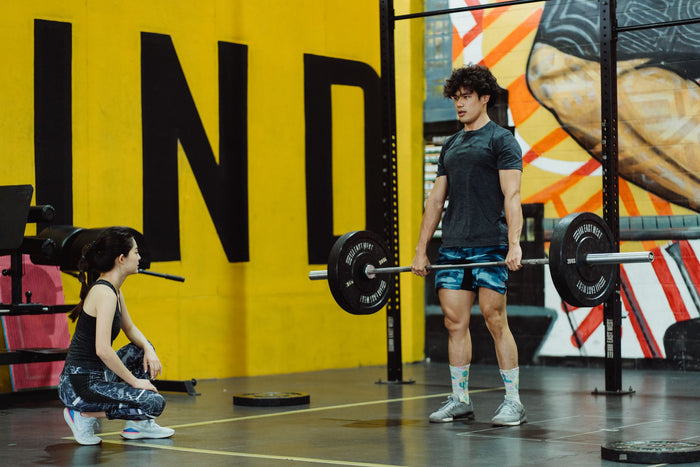
Under the bar, breathing goes fast and shallow. Two or three sighs at the start of the rest period bring the rate down faster than waiting, so the rest interval does what it is for. This is also where the body teaches the mind: the operator who can downshift between sets of five learns to downshift between meetings.
The five-minute daily practice
This is the protocol from the trial, adapted only in where it sits in the day.
- Fix the slot. The trial did not prescribe a time of day. The Apex recommendation is the end of the evening review, because the review already has a chair, a timer and a closed laptop. A protocol that borrows an existing appointment survives.
- Sit or lie down. Timer: five minutes.
- Breathe the pattern continuously. Slow nasal inhale, short nasal top-up, long full mouth exhale. Repeat for the whole five minutes. The trial's instruction was to "repeat this pattern of breathing for 5 min" and then "return to breathing normally."
- Log it. One line: done, and a one-to-five rating of how you feel. The trial's dose effect was about consecutive days, so the record is part of the method.
- Hold for 28 days before judging it. The trial ran for a month and found the benefit grew with days practised. Two weeks is not a test.
Frequently asked questions
What is a physiological sigh?
A physiological sigh is two inhales through the nose, the second a short top-up that fully expands the lungs, followed by one long, complete exhale through the mouth. The body does it reflexively every few minutes to reinflate the lung's air sacs, and more often under stress. Done deliberately, one to three sighs act as a rapid downshift, and five minutes a day was the practice tested in a 2023 randomised trial.
How many physiological sighs should you do?
One to three for an immediate state change, for example after a hard call or before speaking. For a daily practice, the 2023 trial used continuous cyclic sighing for five minutes a day over a month and found the mood benefit grew with the number of days practised. Stop if you feel lightheaded; a minority of participants in the trial reported negative experiences with the exercises.
Is the physiological sigh better than box breathing?
In the one randomised trial that compared them, cyclic sighing produced the largest improvement in daily mood and the largest reduction in respiratory rate, and it was the only breathing group whose mood advantage over mindfulness meditation was statistically significant. The groups were small and the study was exploratory, so treat it as a lean rather than a verdict. Box breathing remains useful for training breath control over several minutes.
Why does the second inhale matter?
The trial authors identified two features that set cyclic sighing apart: extended exhalation and "the double inhale, which increases the depth of inhalation." Research on the sigh circuit describes the sigh's job as reinflating alveoli, the lung's small air sacs, which partly collapse during shallow breathing. The second inhale provides that top-up; the long exhale provides the slowing effect shared with other slow-breathing practices.
How long does a physiological sigh take to work?
A single cycle takes around ten seconds, and the subjective shift is usually felt within one to three breaths, though that speed was not the outcome the trial measured. The trial measured daily mood and respiratory rate over 28 days of five-minute practice and found both improved more than with mindfulness meditation. For a lasting effect, the evidence points to daily repetition rather than occasional use.
Is the physiological sigh safe?
For healthy adults it is a gentle, slow-breathing practice, and the trial reported that 90% of participants had positive experiences. It is not established as safe for everyone: the trial excluded people with heart disease, glaucoma, a history of seizures, pregnancy and several psychiatric conditions. If any of those apply to you, talk to your doctor first, and stop any breathing exercise that causes dizziness or distress.
A reflex, taken on purpose
Operators collect tools that cost money and require set-up. The physiological sigh costs nothing and was installed before you were born. The only thing added is the decision to use it on purpose, at the moments that decide your day.
That is the compound principle in its smallest form. The body already runs a system for recovering from load. The discipline is to reach for it deliberately, between the set and the next set, between the call and the next call, before the mind has finished telling you a story about what just happened.
If you want the daily structure that holds practices like this in place, the free 5-Day Stoic Operator Challenge installs the training rhythm, the evening review and the fixed appointments that turn a thirty-second breath into an operating habit.